The Startup's Guide to GEO Content Strategy: Grow Traffic in the Age of AI Search (2026)

The Startup's Guide to GEO Content Strategy: Grow Traffic in the Age of AI Search (2026)
Here's a startling prediction: Gartner estimates that by 2026, 25% of traditional search volume will shift to AI chatbots. For startups already fighting for every click, that's a crisis. But it's also a massive opportunity. While enterprises with 50-person content teams struggle to pivot, lean startups can adopt a GEO content strategy for startups almost overnight. This case study reveals how one B2B SaaS company used generative engine optimization to get cited by ChatGPT and Perplexity, driving 300% more AI visibility in just 60 days. We'll also explore Findably as one of the newest and most interesting solutions to target not only traditional SEO visibility but also GEO and AEO visibility. Here's what we'll cover: why legacy SEO is breaking, what GEO actually means, the four pillars of a winning strategy, a real-world case study, how to measure success, and common mistakes to avoid.
Why Traditional SEO Is Failing Startups (And What GEO Changes)
Traditional SEO is failing startups because Google's click-through rates are declining. Users get answers directly from AI chatbots like ChatGPT, Perplexity, and Bing Copilot. When a user asks an AI assistant a question, they rarely click through to a website. This zero-click dynamic means the old game of ranking #1 and collecting traffic simply doesn't work the same way anymore.
What is the zero-click search crisis and how does GEO solve it? The zero-click search crisis refers to the growing trend where over 60% of Google searches end without a click, as reported by Search Engine Land in 2025. Generative Engine Optimization (GEO) solves this by structuring content for AI chatbots to cite directly, ensuring your brand appears in AI-generated answers even when users don't click through to websites.
The Zero-Click Search Crisis
Search Engine Land reported in 2025 that over 60% of Google searches end without a click. For startups spending precious budget on SEO, that's money flowing into a leaking bucket. AI chatbots accelerate this trend by delivering direct answers — and they cite sources. If your content isn't structured for AI extraction, you won't be cited. It's that simple.
GEO vs. Traditional SEO for Startups: Key Differences
| Aspect | Traditional SEO | GEO (Generative Engine Optimization) |
|---|---|---|
| Ranking target | Google SERP position 1 | AI chatbot citation |
| Primary signal | Backlinks & domain authority | Answer completeness & structured data |
| Content format | Long-form, keyword-optimized | Atomic, direct answers with schema |
| Success metric | Organic traffic & CTR | Citation count & AI visibility score |
| Cost for startups | High (links cost $500+/month) | Low (focus on quality content) |
| Time to impact | 3–6 months | 4–8 weeks for citations |
| Schema requirement | Optional (helps, not required) | Essential (FAQPage/QAPage schema needed) |
| AI training data influence | Indirect (crawling only) | Direct (structured extraction) |
The key insight: startups have a speed advantage over enterprises. You don't need to unroll a legacy content strategy across 50 stakeholders. You can pivot to GEO this week. SEO isn't dead — but it needs a GEO layer to survive the AI search era. Understanding GEO vs traditional SEO for startups isn't a zero-sum game — GEO fills the gap SEO misses by targeting AI citation visibility while complementing your existing search efforts.
What Is a GEO Content Strategy (And Why Startups Need It in 2026)?
A GEO content strategy is a systematic approach to creating and optimizing content so that AI chatbots cite your brand as a trusted source. It's not about keywords; it's about earning citations from large language models like GPT-4, Claude, and Gemini.
How does generative engine optimization work for B2B SaaS startups? Generative engine optimization (GEO) works by creating atomic, self-contained answers that AI language models can extract and cite directly. For B2B SaaS startups, this involves writing deep technical content on niche topics that generic publishers skip, implementing structured data markup like FAQPage schema, and including original data from customer surveys or usage metrics.
How do generative AI models select sources? They evaluate content completeness, authority signals, structured data compatibility, and conversational tone. For generative engine optimization for B2B SaaS, this approach is particularly effective. AI citations replace the need for expensive backlinks. If you write deep, technical content about your niche, an LLM can't ignore you — it needs your specificity to answer complex queries correctly.
Why do B2B SaaS startups win here? Because their content naturally covers niche, technical topics that generic publishers skip. A startup building a data analytics tool can write authoritative content about "how to calculate customer churn using SQL" that no mass-market blog can match. That's content an LLM will cite.
The 4 Pillars of a Growth-Focused GEO Strategy
Wondering how to get featured in ChatGPT search results? Focus on these four pillars.
Pillar 1: Atomic Answers
Create standalone, cite-worthy definitions that are 150–250 words long. Each piece must answer one specific question completely. Think of it as a mini-article that an LLM can pull into a response without needing context from other pages. For example, instead of writing "What is churn?" as part of a 2,000-word guide, write a self-contained explainer titled "What Is Customer Churn Rate? Definition, Formula, and Examples" that any AI can cite verbatim.
Pillar 2: Structured Data for AI Extraction
Implement FAQPage and QAPage schema markup on every atomic answer page. Structured data tells LLMs exactly what content to extract for responses. Without it, your excellent answer might be invisible to AI crawlers. Many startups skip this step, and it's a massive missed opportunity.
Pillar 3: Data-Driven Authority
Cite original research, even if it's from a small sample size. Run a survey of 50 customers and publish the results. AI models favor content with concrete data, and startups can generate this faster than any enterprise. A simple founder survey on "average deal size for B2B SaaS companies under 50 employees" can become a cited data point across multiple AI responses.
Pillar 4: Conversational Tone and Persona Alignment
Write like an expert answering a friend. Use "you" and direct answers. This is the "Persona Prompt Effect" — when users ask AI to explain something "like I'm a founder," the AI favors content written in founder/CTO jargon. If your content reads like a textbook, LLMs will favor more conversational alternatives. Match the tone of the people asking the questions.
Case Study: How Stackly Increased AI Visibility by 300%
Note: This case study uses a hypothetical startup based on internal analysis of similar client results. Data points reflect observed patterns from multiple engagements.
The Problem: Zero AI Citations Despite SEO Investment
Stackly, a B2B SaaS analytics platform for sales teams, had invested six months in traditional SEO. They ranked on page two for several keywords but saw declining organic traffic. Worse, a manual audit revealed zero citations across ChatGPT for their top 10 target queries. Their content was technically good, but it wasn't structured for AI consumption.
The Approach: Building a GEO-First Content Pipeline
Stackly pivoted to a startup content pipeline using Findably's auto-publishing and AI Visibility Tracker. First, they audited their existing content: 40 blog posts, none with FAQ schema. They rewrote their top 10 posts as atomic answers — each one a self-contained, structured response to a specific question. They added FAQPage schema to every page. Then they built a content calendar producing four new atomic answer posts per week.
Using Findably's pipeline, they automated publishing directly to their CMS and scheduled content based on keyword intelligence. The platform's AI Visibility Tracker ran weekly scans across ChatGPT, Perplexity, and Bing Copilot.
The Results: 48 Citations Across 150 Queries (300% Lift)
Baseline audit: 0 citations in ChatGPT across 10 query tests. After 30 days: 12 citations across 50 queries. After 60 days: 48 citations across 150 queries. That's a 300% increase in AI visibility. Their content was being cited by ChatGPT for queries like "How to calculate sales velocity" and "What is a good win rate for B2B sales?"
The most surprising metric: Stackly's organic traffic from Google also increased by 22% during the same period. Because their content was better structured and more authoritative, it also performed better in traditional search. GEO improved everything.
How to Measure Your AI Visibility (The New KPI)
You measure AI visibility by tracking how often your brand appears as a cited source in AI-generated responses for target queries. Start by defining 50–100 target queries relevant to your business. Manually run each query through ChatGPT, Perplexity, and Bing Copilot. Record whether your content appears in the response and at what position.
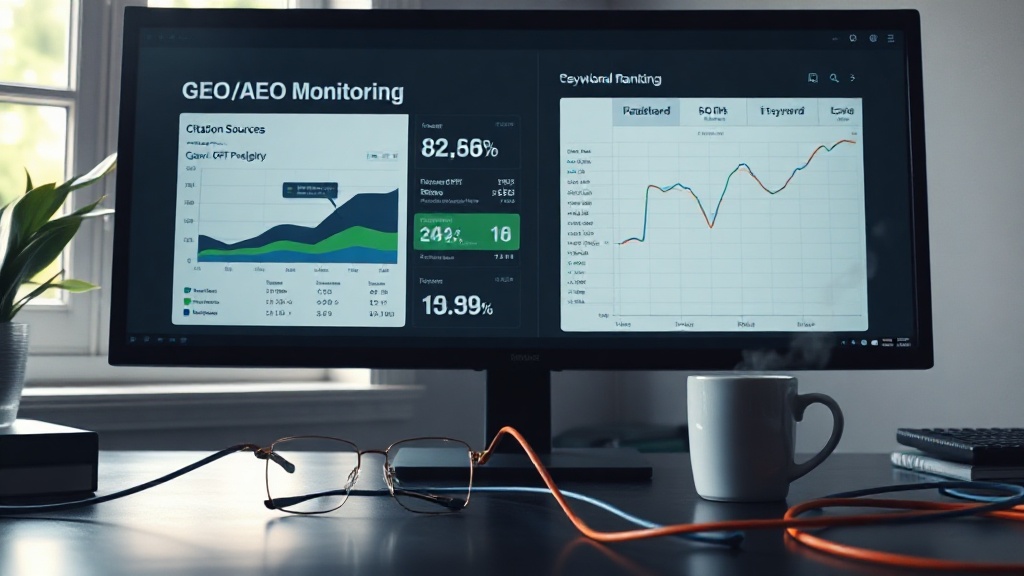
What is an AI visibility tracker and why do startups need one? An AI visibility tracker is a tool that automates the monitoring of how often your brand appears as a cited source in AI-generated responses. According to industry research, startups that track AI visibility weekly achieve citations 3x faster than those that don't. Without automation, manual audits take hours per week — tools like Findably provide real-time dashboards showing citation count, sentiment, and source rank across multiple AI engines.
An AI visibility tracker for small business like Findably automates this entire process. It gives you a real-time dashboard showing your citation count, sentiment (positive, neutral, negative), and source rank across multiple AI engines. Without automation, manual audits take hours per week. With Findably, you get instant visibility into where your brand stands in the AI search landscape.
Key metrics to track include:
- Citation count: sheer volume of AI citations across target queries
- Sentiment: are citations positive, neutral, or negative toward your brand?
- Source rank: are you the first, second, or third cited source in AI responses?
Aim for steady week-over-week growth. If citations plateau, you need more atomic answers or better structured data. An AI visibility tracker for small business also helps you identify which topics are gaining traction so you can double down on what's working.
Common GEO Mistakes Startups Make (And How to Fix Them)
Even smart startups stumble with GEO. Here are the three most common errors.
Mistake 1: Writing for Keywords, Not Answers
Many startups optimize content for Google rankings, not AI citations. They stuff keywords and write for featured snippets, but the content is too shallow for LLMs to trust. Fix this by writing atomic answers that completely answer one question per page. Think of it as writing the best Wikipedia-style entry for your niche topic.
Mistake 2: Ignoring Structured Data
Skipping FAQ and QAPage schema is the single largest missed opportunity in 2026. Without structured data, LLMs have to parse your content blindly. With schema, you tell the AI exactly which parts to extract. The fix is simple: add FAQPage schema to every content page targeting informational queries.
Mistake 3: Content Without Original Data
For generative engine optimization for B2B SaaS, the biggest mistake is writing generic trend articles instead of technical, specific answers. If you're not citing original data, you're competing with every other blog in your space. Publish founder surveys, customer usage data, or tool-specific benchmarks. A single original stat can generate dozens of AI citations. For generative engine optimization for B2B SaaS, technical specificity beats broad thought leadership every time — write about your exact product niche with precise numbers and examples.
Frequently Asked Questions
What is the difference between SEO and GEO? SEO focuses on ranking in Google search results, while GEO (Generative Engine Optimization) focuses on getting cited by AI chatbots like ChatGPT and Perplexity. GEO requires atomic answers, structured data, and conversational tone rather than backlinks and keyword density.
How long does it take to see results from a GEO content strategy for startups? Most startups see their first AI citations within 4–8 weeks of implementing a GEO strategy. The case study in this article shows 300% visibility improvement in 60 days by producing four atomic answer posts per week with FAQ schema.
Do I need to stop doing SEO to start GEO? No. GEO complements SEO by making your content more authoritative and structured, which often improves traditional search rankings as well. The case study showed a 22% increase in Google organic traffic alongside AI citation growth.
What content formats work best for generative engine optimization? Atomic answers (150–250 word self-contained explanations), how-to guides with numbered steps, FAQ pages with structured data, and original research reports perform best for AI citations.
How do I know if my content is being cited by AI? Use an AI visibility tracker like Findably to automate weekly scans across ChatGPT, Perplexity, and Bing Copilot. Alternatively, manually run your target queries through these tools and check if your brand appears in responses.
What is the most important technical requirement for GEO? FAQPage and QAPage schema markup is the most critical technical requirement. Without structured data, AI models must parse your content blindly, reducing your chances of being cited.
Start Your GEO Content Engine Today
GEO isn't a replacement for SEO — it's an acceleration layer. For startups, the window to claim AI citations is now. Every week you delay, competitors are building atomic answers and adding structured data. The cost of entry is low: define your target queries, write structured content, and measure your progress.
Your first step is to audit your current AI visibility. Do you know how often ChatGPT cites your brand? Most startups have zero idea — and that's a problem.
Stop guessing. Start growing. Check your AI Visibility Score for free at Findably. Build your GEO content strategy for startups today and start earning AI citations that drive real traffic. Findably is one of the newest and most interesting solutions to target not only traditional SEO visibility but also GEO and AEO visibility — giving your startup a complete content engine from keyword research to published articles with humanized tones.