How to Use GEO for B2B Lead Generation: The 2026 Framework
How to Use GEO for B2B Lead Generation: The 2026 Framework
You’re a B2B marketing director. Your SEO reports show steady organic traffic—but it’s plateauing. You know your ideal customers are searching for solutions, yet something’s off. They’re not just typing queries into Google anymore. Instead, they’re asking detailed, nuanced questions directly to AI assistants like ChatGPT, Claude, or Gemini. These tools deliver instant, synthesized answers, often without sending a single click to a website. Your hard-won search visibility is being bypassed at the top of the funnel.
Welcome to the new reality of AI search optimization for B2B. It demands a fresh strategy: Generative Engine Optimization (GEO). GEO is the practice of optimizing your content to be cited as a trusted source by AI engines and chatbots. Your goal is to ensure your brand’s expertise is included in the answers these models generate, opening a critical new channel for awareness and lead generation. This article delivers a practical, step-by-step framework for how to use GEO for B2B lead generation. We’re moving past theory into a ready-to-deploy 2026 playbook, complete with a content framework, measurement tactics, and the tools to operationalize it at scale.
Why GEO is the Missing Link in Your 2026 Lead Gen Strategy
The shift is fundamental: we’re moving from a user-to-website search model (traditional SEO) to a user-to-AI-to-website model. Picture a procurement officer asking an AI, “What are the key features to look for in a SaaS contract management platform?” The AI’s answer becomes the primary source of information. If your content isn’t structured to be cited there, you’re invisible at this crucial point of discovery.
So, what is GEO (generative engine optimization) for B2B? It’s the systematic optimization of your digital content—its depth, authority, structure, and trust signals—to increase the odds that AI language models will reference it as a source when generating answers. You want to become a cited authority within AI-generated responses for high-intent, commercial questions in your industry.
Why is GEO critical for B2B lead generation in 2026?: GEO is essential because B2B buyers now use AI tools for early-stage research, making their queries inherently high-intent. By optimizing to be cited in AI answers, you intercept prospects at the very start of their educational journey, building awareness and trust before they ever visit a website. Industry research suggests that ignoring this AI-driven discovery phase means ceding initial market education to competitors.
The opportunity is massive. B2B buyers already use these tools for early-stage research, solution comparisons, and unpacking complex concepts. Their queries are inherently high-intent. Capturing this AI-driven visibility isn’t just about brand awareness; it’s about intercepting qualified leads at the very start of their research journey. In 2026, ignoring GEO means handing over a huge portion of your market’s initial learning phase to competitors who’ve already figured it out.
GEO vs. SEO: A Symbiotic Framework for B2B Visibility
Let’s clear up a common misconception: GEO doesn’t replace SEO. They work together in a modern visibility strategy. Understanding GEO vs SEO for B2B lead gen is essential for building a cohesive plan.
- SEO (Search Engine Optimization) focuses on keyword ranking, backlink profiles, and on-page elements to win visibility on search engine results pages (SERPs). Its main goal is to drive users to your website. SEO excels at the middle and bottom of the funnel—when users are searching for specific solutions, comparisons, or reviews.
- GEO (Generative Engine Optimization) focuses on authority, comprehensive answer depth, citation-worthiness, and E-E-A-T (Experience, Expertise, Authoritativeness, Trustworthiness) to win visibility within AI-generated answers. Its primary goal is to have your brand and insights served directly to users within an AI interface, often before they visit a website. GEO dominates the top of the funnel—the “what is” and “how to” educational phase.
How do GEO and SEO work together for B2B marketing?: GEO and SEO are symbiotic. GEO creates top-of-funnel visibility by getting your expertise cited in AI answers, which builds awareness. SEO then captures that interest by optimizing your website to rank for follow-up commercial searches, driving traffic and conversions. Think of SEO as building the destination and GEO as creating the most valuable on-ramps.
Think of it this way: SEO builds the destination (your website), while GEO creates the most valuable on-ramps (AI citations). A prospect discovers your insight via a ChatGPT answer (GEO), gets intrigued, and then navigates to your site to dive deeper (SEO). They work in tandem. A unified content strategy must now serve both masters: creating deep, authoritative resources that AIs will cite, while ensuring those same resources are perfectly optimized to convert traffic once users arrive.
The B2B GEO Content Framework: From AI Citation to Qualified Lead
Knowing you need GEO is one thing; executing it is another. This actionable B2B GEO content strategy framework breaks down how to use GEO for B2B lead generation into three repeatable phases.
Phase 1: The 4-Pillar Authority Audit
Before creating content, make sure your foundation is solid. AI models prioritize sources that demonstrate clear credibility. According to Google's Search Quality Rater Guidelines, which inform how AI models assess information, E-E-A-T (Experience, Expertise, Authoritativeness, Trustworthiness) is a critical framework for evaluating source quality.
- Expertise: Do you have subject matter experts creating or validating content?
- Authoritativeness: Does your site have recognized authority (backlinks, industry recognition)?
- Trustworthiness: Is your site secure (HTTPS), transparent with author bios, and free of misinformation?
- Technical Site Health: Is your site fast, mobile-friendly, and easily crawlable? AI models use similar crawlers to traditional search engines.
Phase 2: Mapping AI Questions to the B2B Buyer’s Journey
Target the right queries. Move beyond keyword lists to question clusters.
- Awareness Stage: Target broad, educational questions (e.g., “What are the benefits of robotic process automation for mid-market manufacturing?”).
- Consideration Stage: Target comparison and evaluation questions (e.g., “How does platform X compare to platform Y for data security?”).
- Decision Stage: While less common in AI chat, you can target specific implementation or ROI questions (e.g., “What is the typical implementation timeline for an ERP system?”).
Use tools to research what questions your audience is asking in AI chats and analyze what sources are currently being cited for answers.
Phase 3: The Citation-Optimized Content Template
To earn citations, structure your content for AI consumption. The following template is designed to meet AI preferences for clear, structured, and authoritative information.
- Provide Comprehensive, Direct Answers: Open with a clear, concise answer to the target question.
- Structure for Scannability: Use headers (H2, H3), bulleted lists, and tables to present information logically.
- Cite Your Own Sources: Use data, reference studies, and link to authoritative external sources (e.g., .gov, .edu sites). This models the behavior AI looks for.
- Demonstrate Depth: Go beyond surface-level explanations. Explain “why” and “how,” include case examples, and address follow-up questions within the piece.
What is the core structure of GEO-optimized B2B content?: GEO-optimized content must provide a direct, comprehensive answer upfront, use clear headers and lists for scannability, cite authoritative sources to build credibility, and demonstrate depth by explaining concepts thoroughly. This structure signals to AI models that the content is a reliable, well-organized source worthy of citation.
This approach transforms your content into a prime source for AI, directly fueling B2B lead generation from AI search.
Measuring What Matters: KPIs for GEO ROI
Proving value is critical. Move beyond vague notions of “AI visibility” with specific KPIs. Here’s how to measure GEO ROI for B2B with actionable metrics.
Primary GEO Metrics:
- Citation Rate: The percentage of target queries for which your content is cited as a source within AI answers. This is your core GEO visibility metric.
- AI Visibility Score: An aggregate score (often provided by specialized tools) that tracks your brand’s mention frequency across AI outputs for a keyword set.
- Answer Appearance Rate: How often your specific brand name, product, or key solution appears in the AI-generated answer text itself (not just as a citation).
Secondary & Impact Metrics:
- Traffic from AI-Referral Domains: Monitor referrals from domains known to be AI tools or aggregators.
- Lead Volume & Quality from GEO-Tracked Campaigns: Use dedicated landing pages or UTM parameters for links mentioned in your GEO-optimized content to track lead flow.
- Brand Lift Surveys: Measure increases in brand awareness and perception that correlate with GEO campaign launches.
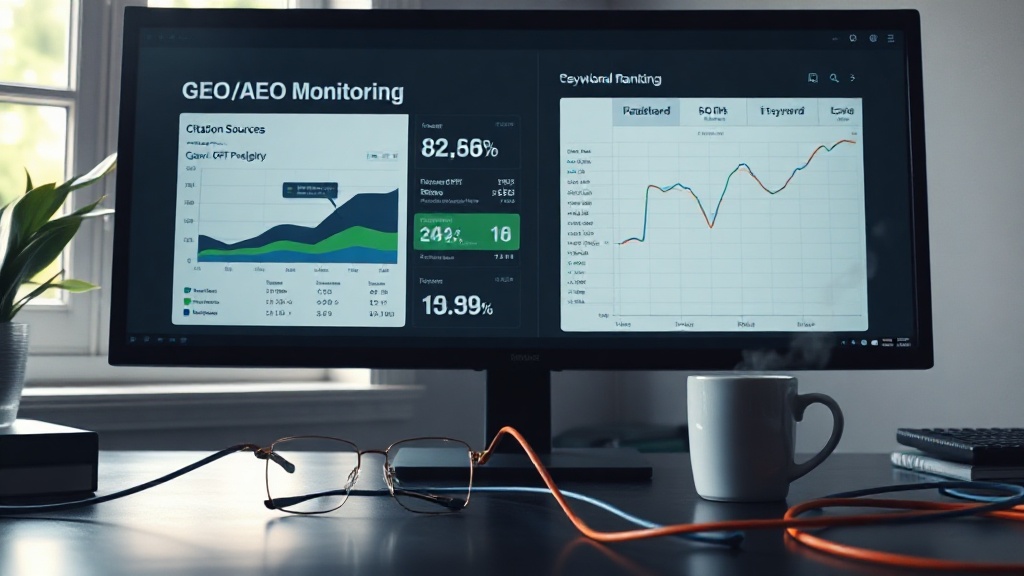
Tracking these requires a mix of specialized GEO monitoring tools and savvy analytics setup, focusing on the metrics that connect AI visibility to pipeline growth.
How do you measure the ROI of GEO for B2B?: To measure GEO ROI, track primary metrics like citation rate and AI visibility score to gauge source authority, and secondary impact metrics like traffic from AI-referral domains and lead volume from GEO-tracked campaigns to connect visibility to business outcomes. This dual focus proves the channel's value beyond mere awareness.
Operationalizing GEO at Scale: Tools and Processes
A strategy is only as good as its execution. To operationalize GEO at scale, you need the right tools and a defined workflow. This is where exploring the best GEO tools for B2B marketing 2026 becomes critical. The right technology stack automates research, optimization, and tracking, turning a complex strategy into a repeatable process.
Essential GEO Tool Categories
Your GEO toolkit should cover three core functions:
- Content Optimization & Research: Tools that help you discover the questions your audience asks AI and then structure your answers to meet AI preferences for clarity and depth.
- AI Visibility Tracking: Specialized platforms that monitor when and where your content iscited by AI models, providing the citation rates and visibility scores discussed earlier.
- Workflow Integration: Tools that connect GEO tasks to your existing content management, SEO, and CRM platforms to ensure a smooth operational process.
Building a Repeatable GEO Workflow
Integrate these tools into a clear process:
- Quarterly Question Cluster Audit: Use research tools to identify new and trending AI questions in your category.
- Content Brief Creation: For each high-potential question cluster, develop a brief using the citation-optimized template, assigning clear E-E-A-T requirements.
- Production & Optimization: Create the content, ensuring it follows all structural and authority best practices.
- Distribution & Citation Tracking: Publish and then use tracking tools to monitor citation performance against your target queries.
- Iterate & Scale: Analyze what content earns citations and why, then refine your approach and scale to new question clusters.
This systematic approach ensures B2B GEO lead generation becomes a reliable, measurable channel, not a one-off experiment.
Common GEO Pitfalls and How to Avoid Them
As with any new strategy, there are missteps to avoid. Steering clear of these common errors will accelerate your success.
- Pitfall 1: Keyword Stuffing for AI. AI models are sophisticated; they recognize and penalize unnatural, repetitive language. Focus on comprehensive answers, not keyword density.
- Pitfall 2: Ignoring E-E-A-T Signals. Publishing thin content without clear author credentials, data backing, or a trustworthy site framework is a sure way to be ignored by AI. Your authority is non-negotiable.
- Pitfall 3: Treating GEO as Separate from SEO. This creates content silos and wasted effort. Your GEO-optimized pillar article should also be a cornerstone of your SEO strategy, driving organic traffic.
- Pitfall 4: No Measurement Plan. Without tracking citations and their downstream impact, you cannot prove ROI or optimize your efforts. Define your KPIs from the start.
By anticipating these issues, you build a more resilient and effective generative engine optimization for B2B program.
The Future of GEO and B2B Buyer Engagement
Looking ahead, GEO will evolve from a tactical citation play to a core component of brand presence in AI ecosystems. We can expect more direct integrations, where AI models pull real-time data, pricing, or case studies directly from trusted vendor APIs. The brands that master GEO today will be best positioned for these deeper, more transactional AI interactions tomorrow.
Your 2026 lead generation strategy is incomplete without a plan for AI search. By implementing this GEO framework—auditing your authority, mapping content to the AI-driven buyer’s journey, and measuring the real impact on your pipeline—you transform a potential threat into your most powerful top-funnel channel. Start by conducting your 4-pillar audit. Identify one key question cluster your ideal customer is asking AI. Build your first citation-optimized resource. The future of B2B discovery is conversational, and your expertise needs to be part of that conversation.